
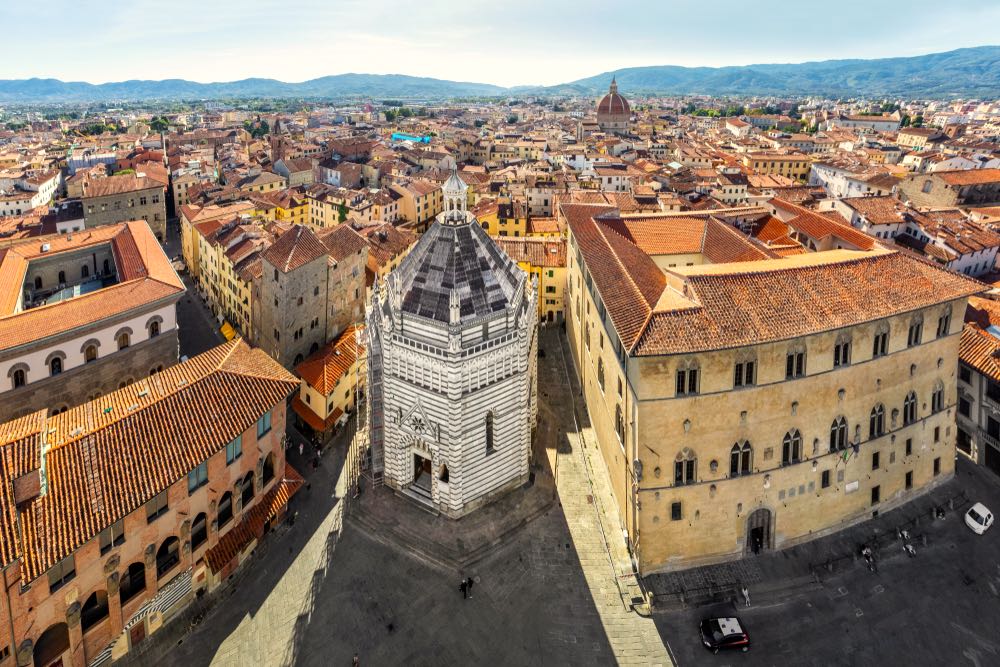
Montalbano, Mons Albanus, a widespread toponym in Italy, derives from the Latin albus, meaning white, highlighting the striking view from afar of this mountain that frames the Pistoia-Prato-Florence plain, along with the Tuscan-Emilian Apennines. This ridge runs from the Serravalle Pass to the Arno River, near the Gonfolina bottleneck in the municipality of Lastra a Signa.
It is a veritable green lung with vast, rounded hills cultivated with vines and olive trees, composed largely of sandstone and pietra serena, materials that give the soil a characteristic gray, almost whitish appearance. This area is densely wooded, with Turkey oak, maritime pine, and downy oak being the most common species, along with Mediterranean scrub. It has been known as a quality winemaking area since the Middle Ages; in fact, at the end of the 13th century, the bishops of Pistoia had Montalbano wine brought to their tables.
Like all of central Tuscany, the Sangiovese language is spoken here, expressed as a subzone of Chianti DOCG. A lively, smooth, fresh, and easy-drinking red, it is at its best when made entirely in steel, lacking brilliance in the more structured versions aged for long periods in wood.
Montalbano has two slopes: a bright and open one facing the Tyrrhenian Sea to the west, as in the areas of Vinci, Lamporecchio, and Cerreto Guidi, and a darker and shadier one to the east, overlooking the Pistoia-Prato plain. It is precisely in this area, in Quarrata (PT), that a historic winery, Fattoria Betti, is located. Its headquarters is the famous Art Nouveau Cantinone Baldi, dating back to 1903. Since 2003, the two young brothers, Guido and Gherardo, have carried on the family’s winemaking tradition. The twenty hectares of vineyards, located in predominantly clayey soils at 150-200 meters above sea level, are primarily grown with Sangiovese grapes. Together with Canaiolo and Colorino, they create a Chianti Montalbano that’s almost thirst-quenching, thanks to its blood orange flavor. Vinified in stainless steel and cement, it also pairs well with tomato-based fish soups, especially when served at 14-15°C.

In the Quarratino area, Cantine Bonacchi is noteworthy. With its Rosso Badesco, from the vineyard of the same name, it has put its stamp on the idea of a typical Pistoia wine.

Also on the same slope, but on the Casalguidi side, renowned nursery entrepreneur Vannino Vannucci has been experimenting with wine production for several years, with encouraging results in terms of quality, which increases year after year. The vineyards, once owned by Tiberi, surround the scenic Residence Bello Stare. Worthy of note are the drinkable Chianti Moreno and the more structured Le Vespe, both Sangiovese-based. A little gem is the Petit, made entirely from Petit Verdot.

Remaining in the Pistoia area but in the Montalbano area overlooking the sea, in Lamporecchio, is the historic Sensi Vigne e Vini which, on the Fattoria di Calappiano estate, with the Chianti Riserva Vinciano and the Super Tuscan Collegonzi, gives shape to a rich and mature Sangiovese, typical of this slope.

Valentino Tesi
(March 2024)


