
(Visit May 2017)
Enthusiasm, excitement, and energy: these are the emotions Leonardo Pizzolo evokes when he talks about his history and his winery, Valle Reale.
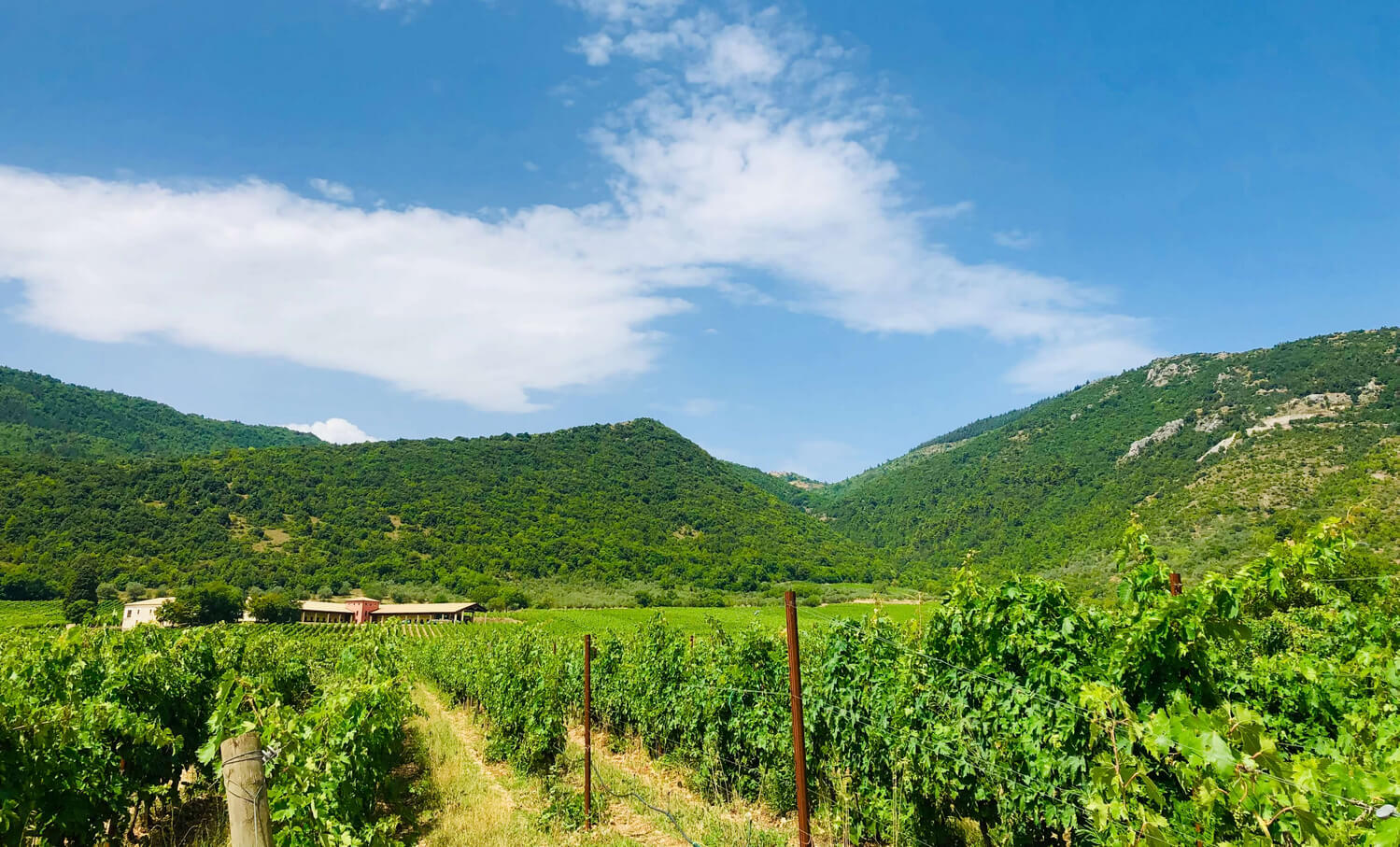
We are in the Peligna Valley, just outside Popoli, the only crossing point between the Majella and Gran Sasso mountains, unless you choose to climb the mountains to cross them.
A pristine place, surrounded by nature reserve forests and crystal-clear streams, it is here that the Gran Guizza wine is bottled and the last remaining species of Marsican brown bear live, along with expanses of meadows dominated by dandelions, mugwort, and wild fennel.
Leonardo loves his work; you almost gawk at him as he highlights the challenges of viticulture in an often hostile terrain. He’s one of the few wineries, indeed the only one in the region, located behind the two great mountains of Abruzzo, thus excluding the warm marine air that blows from the Pescara plain off the Adriatic. It’s an area where late spring frosts are commonplace, where the highly draining soil often suffers from drought if rainfall isn’t evenly distributed throughout the year. It’s a place where he often has to contend with various animal species that feed on the ripe grapes. A land for the tough, the stubborn, and those in love with their work—just the perfect description of Leonardo Pizzolo.
A Venetian, Leonardo, with a passion for wine passed down from his uncle, a bottler, arrived in this region in 1999, thanks to the family business in Popoli, and fell in love with it. He decided to move permanently to Abruzzo and began restoring the family property, a farmhouse nestled among the vineyards, and restored the old Trebbiano and Montepulciano pergolas. The early years were those of conventional, correct, textbook viticulture, with selected yeasts. The wines produced were flawless, even good according to their market success, but they didn’t convince Leonardo. The flavor was too standardized, lacking in typicality, and didn’t reflect the mountainous Abruzzo in which the vineyards are nestled. The selected yeasts used impart aromas of ripe tropical fruit, which can be found in a white from the Aosta Valley or Sicily. Leonardo couldn’t stand it and began to travel; intuition took him to Burgundy, where, among other things, he met Emmanuel Merlo, a young French winemaker who still oversees the work in the Valle Reale cellar. In this magical land, thanks largely to Roulot, he learned a different way of making wine, one that involves spontaneous fermentation, indigenous yeasts, and the pied de cuve. He returned to Abruzzo and revolutionized everything; his Trebbiano was intended to be a standard-bearer for those places. The first experiments weren’t encouraging, with extremely slow fermentations that struggled to get going and often stopped. After all, nature can’t be controlled with a remote control—one day conventional, the next natural. It takes time, patience, and all the elements must come together, step by step. Thus, in 2007, he completed his first experiment, using Trebbiano from the Capestrano vineyard: the first spontaneously fermented wine. He tasted it and was astonished; it was like lemonade, with a scathing acidity. He was demoralized, believing he’d never be able to create what he envisioned in that area. As luck would have it, not far from him lives a beacon of regional and Italian winemaking: Francesco Paolo Valentini, who has elevated Trebbiano to the pinnacle of winemaking. Leonardo decides to take it to him for a taste, and his response is surprising: the wine is good, with potential, but it needs time to balance, to smooth out the rough edges. Reassured, he realizes he’s on the right path, improving and perfecting himself, and year after year his Trebbianos, from the various crus—Popoli, Capestrano, and Vigna del Convento—become increasingly standard-bearers of those pristine lands.
Montepulciano subsequently followed the same path, with the San Calisto and Sant’Eusanio crus.
It’s difficult to define Leonardo Pizzolo’s viticulture with a single term: organic? Biodynamic? Eco-sustainable? I’d say he’s a keen observer of nature, an intelligent man, respectful of the environment, so much so that he’s at the forefront of the “no Snam gas pipeline” movement, a monstrosity that would threaten to overturn the intact ecosystem of this valley. He’s so meticulous in recording climate and meteorological events that he keeps a hand-written diary of each vintage, complete with photographs, noting recorded events such as frost, hailstorms, drought, and the remedies implemented. He’s convinced that this diary will be useful to his son, now a newborn, when he too becomes a winemaker. Moving.
It’s thanks to people like Leonardo that I’ve immersed myself in the world of wine, who make respectful winemaking a lifestyle, a mission, not necessarily tainted by exclusive market logic.
The difficulties he faces every season are countless, the most trying being undoubtedly the late spring frosts, typical of this mountainous area, where at night, even in late May, the temperature can dangerously approach freezing. He even purchased the famous Burgundian stoves, although he has never used them yet. He maintains that the best way to combat frost is the high Abruzzo pergola, as the cold is concentrated low down, sparing the buds that can reach heights of over two meters. It’s no coincidence that the friars of the Convent that once stood where Valle Reale now stands used this system, which, among other things, prevents wild boars and leverets from feeding on the ripe grapes. “Observe” is once again the motto Leonardo invites us to reflect on.
Drought also presents a significant challenge, given the soil’s very draining structure, with very little clay and a lot of sand. Valle Reale would benefit from light but constant rainfall rather than sporadic, heavy rains, as has increasingly been the case in recent summers.
Wines produced with these values and efforts certainly have added value.
Let’s move on to the tasting notes, starting with the Trebbiano and continuing with the Montepulciano, all fermented spontaneously with indigenous yeasts, as mentioned:
- Trebbiano d’Abruzzo DOC Vigneto di Popoli 2015. This is one of the estate’s historic vineyards, featuring the remains of a cave-cellar dating back to around 1300. Here, the Benedictine monks, descending from the Convent located in San Benedetto in Perillis, a tiny village clinging to the mountains behind Valle Reale, made and stored their wine. The vines are espalier-trained. This is the cru from which the crispest and most citrusy Trebbianos come. Only stainless steel. The 2015, barely hazy as it is unfiltered, offers lime and green notes of wild fennel, mugwort, calamint, and medicinal herbs on the nose, in a succession of great finesse. On the palate, it is sharp, with a lasting finish of fresh mandarin and sage. It still has a lifetime to smooth out its strong acidity.
- Trebbiano d’Abruzzo DOC Vigna del Convento di Capestrano. The latest cru to be created in the municipality of Capestrano, higher up than Popoli but also with higher temperatures, near the Ofena plain, the “forno d’Abruzzo,” 4.5 hectares of Guyot-trained Trebbiano. This wine also ages exclusively in stainless steel. This portion produces fruitier, more rounded Trebbianos, but still with the unmistakable territorial signature of the floral aromas that surround the vines. Lightly hazy, the nose features pear and white peach with nuances of helichrysum, wildflowers, broom, and acacia. The palate is guided by a balanced savoriness that plays with freshness, in a textbook alcohol content. This wine also has a very long development potential.
- Montepulciano d’Abruzzo DOC San Calisto 2012. This is the vineyard you encounter as soon as you arrive at the winery, the historic, original Abruzzo pergola-trained one. Ancient vines, from whose buds the Popoli vineyard was born, through grafting. A bright ruby color that still retains vivid youthful reflections. It opens with dark fruity nuances of blackberries and blueberries, then veers towards territorial notes of lavender and balsamic notes. Elegant spiciness of green pepper and a subtle hint of cinnamon. On the palate, it displays smooth, enveloping, soft, almost silky tannins. On the palate, the wine is light, lean, and pleasant, with consistent returns of wild berries. It ages in old 25-hectoliter barrels. It’s difficult to find a Montepulciano d’Abruzzo that is so drinkable; evidently the mountain soil and climate play their part.
- Montepulciano d’Abruzzo DOC Vigneto di Sant’Eusanio 2015. This is the cru that captivated me. Its location is striking. From the winery headquarters, you look north and see a small plot of vineyard surrounded by a pine forest on all four sides, with soil full of pebbles. The vineyard is high, almost 500 meters above sea level, with temperatures even colder than in Popoli, with incredible day-night temperature variations, even 30 degrees in spring and summer. The result is an uncompromising Montepulciano, far from the Abruzzo tradition of this grape, which often gives a nod to the sweetness of dark fruit. The Vigneto di Sant’Eusanio is slender from the color, a transparent ruby, with a captivating, variegated nose of roots, leather, heather, and cranberry. The palate is sharp, with a vibrant acidity of unripe berries and crisp sour cherry. Juicy flavor, with almost imperceptible tannins, impressive drinkability. Close your eyes and it tastes like a Beaune Pinot Noir. Try it even at 12°C on a sultry summer evening with a tomato-infused red mullet stew. Obviously, it isn’t produced every year because the issue of phenolic ripeness in this vineyard isn’t superfluous. It ages exclusively in stainless steel.
I’m sure the future holds more surprises. Leonardo is a never-ending volcano. Various experiments are brewing in the cellar, including a Trebbiano vinified according to Burgundian principles, in barriques with bâtonnage. I had the privilege of tasting it and was literally blown away by its excellence. For now, he’s enjoying it privately, but the day it will be on the shelves of wine shops is not far off.
We hope the Trebbiano d’Abruzzo DOC will be renewed, adapted, and enhanced by the various subzones that inevitably exist in a designation that encompasses an entire region. Winemakers like Leonardo Pizzolo must be safeguarded; they are champions and defenders of breathtakingly beautiful, pristine territories that deserve to be preserved. While we wait for something to change, we will continue to enjoy the elegance and finesse of the Abruzzo mountain wines of Valle Reale.
Valentino Tesi
(December 2022)


