
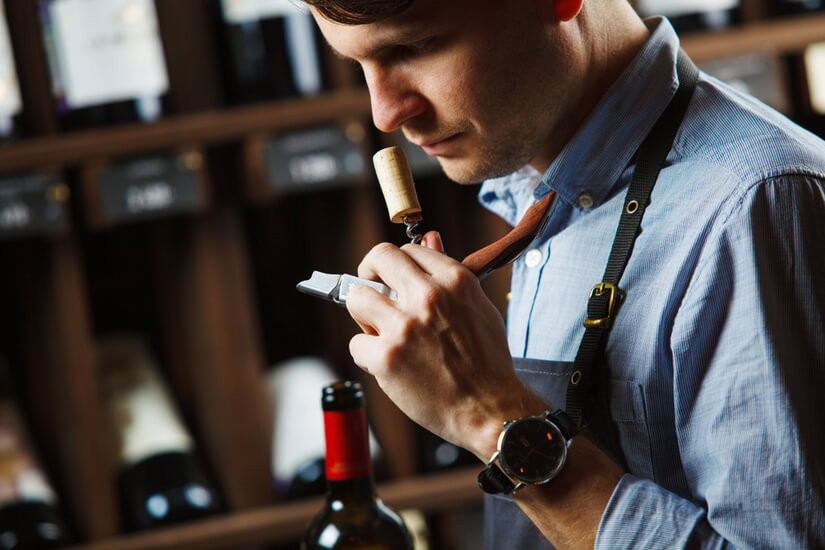
Who hasn’t experienced this at least once in their life? Perhaps during a romantic dinner at home, with the woman you’re intensely courting, you decide to uncork the big bottle you’ve long coveted, and bang! It smells like cork.
One of the worst experiences a wine lover can have is the dreaded cork taint. You don’t have to be an expert sommelier to recognize this odor, reminiscent of mold, wet cardboard, or a cupboard closed for months—and therefore rather unpleasant odors.
The pervasive sense of anger and frustration is difficult to avoid, especially if the bottle in question had been saved for a long time for a special occasion and is expensive.
Every year, 360 million bottles of wine worldwide end up in the sink, an estimated four out of every 100 bottles sold. Beyond the feelings of disappointment and anger, the damage to the wallets of customers and producers is obviously the greatest harm.
In the past, it was believed that the cause was solely due to improper wine storage. Recently, however, it has been proven that the culprit is a small fungus that lives naturally in the bark of the cork oak, Armillaria mellea. This fungus, when combined with chlorides used for bleaching and sanitizing purposes, forms a chemical compound called TCA (2,4,6-trichloroanisole), which releases all the classic “cork defect” aromas.
That said, it’s easy to understand that the less the cork is processed with other components, the less likely chemical reactions will occur. In fact, the best corks, those for high-quality, very expensive bottles, are the so-called “single-piece” ones, 4-5 cm long, which can cost as little as €1.50 each, the same as a mediocre discount wine.
However, just when the solution seemed within reach—that is, avoiding the use of chlorine in cork processing—scientific advances led to other discouraging discoveries. Indeed, it seems that the characteristic odor can develop even when the cork is attacked by fungi other than Armillaria, such as Aspergillus or Penicillium, which are present in the cellar and not on the cork. Bacteria of the genera Bacillus, Rhodococcus, and Streptomyces may even play an active or contributing role. These microorganisms can produce other undesirable compounds such as pentachloroanisole and guaiacol. In this case, hygiene and cleanliness in the cellar would appear to be able to avoid the problem.
The attentive reader is certainly already wondering, why not eliminate cork as a material? There are also historical and cultural resistances; cork represents tradition and romance. Especially in the Old World, consumers would be hard-pressed to tolerate a great wine with a closure other than cork. Can you imagine a Sassicaia, a Tignanello, or a great Barolo with a screw cap? We’d be shocked! Unlike in the New World such as California, Australia, South Africa, even premium bottles are corked with Stelvin.

Indeed, research has long been focused on studying other materials with similar insulating properties. Soon, single-piece cork stoppers will be used for very few bottles, only those suitable for very long cellaring. This is not only to prevent cork defects, but also because the raw material is increasingly scarce in nature. The oak tree from which cork is extracted is an increasingly rare tree: Portugal produces 60% of the world’s production, followed closely by Spain and Italy. Sardinian cork is considered the most valuable but also the most difficult to find. Once the oak is planted, it takes twenty-five years for the bark to develop its quality. It regrows after nine to twelve years, reaching a thickness of about 5 cm without the irregularities and defects of the first cycle. At that point, the oak is ready for debarking, a process performed by hand to avoid damage to the tree, which is marked with a number indicating the year of debarking.
Research is focused on quality and, above all, sustainability, with the introduction of plant-based polymers derived from sugar cane, in addition to the already well-known Stelvin screwcaps, glass caps, and silicone caps.
Younger consumers, not rooted in the cork tradition, are developing a greater awareness of environmental issues. Communication strategies are changing, as is the focus on new alternative closures, often just as effective as traditional ones and more eco-friendly.
Clearly, producers of these alternative closures guarantee quality results identical to cork, and to this end, they are increasingly organizing blind tastings for potential buyers, giving them the opportunity to sample the same bottle sealed and cellar-aged with different corks.
Cork guaranteed to be TCA-free is even emerging, thanks to the use of a technology that scans trichloroanisole molecules, initially developed for NASA. This mass spectrometer is designed to provide real-time analysis aboard spacecraft, with the aim of instantly identifying any hydrogen leaks.
Despite all these modern advances and technologies, the sommelier’s advice is to avoid the risk of a corked bottle for the special occasion, necessarily resorting once again to old common sense: “Always take the good when it comes, because the bad is never lacking.”
If you’re fortunate enough to have an exceptional bottle in your hands, there’s no need to wait for special occasions; the wine will make any moment extraordinary and unforgettable. To quote a great Tuscan, Lorenzo de’ Medici, “He who wants to be happy is not certain of tomorrow (or of the cork).”
Valentino Tesi
(April 2023)


