
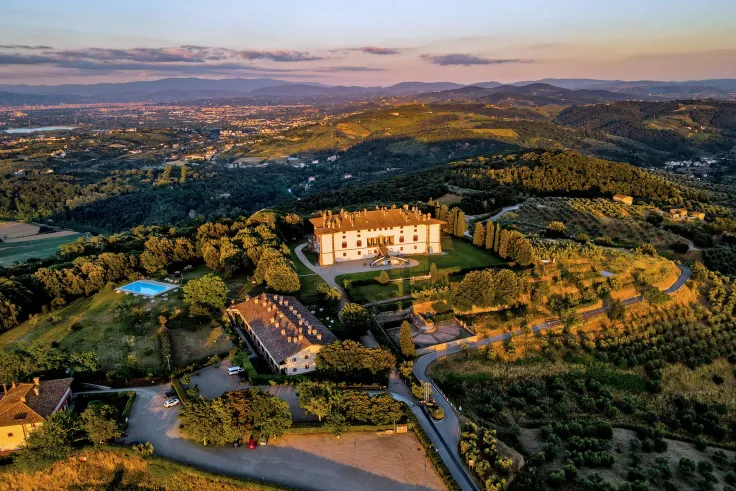
“But if I take a jar in my hand/of brilliant Carmignano,/it rains so gratefully into my breast,/that I do not envy Jove ambrosia and nectar.” So wrote the poet-scientist Francesco Redi in 1685, through the verses of his celebrated work Bacco in Toscana.
Even then, the red wine of Carmignano, a charming village in the Montalbano area of Prato, enjoyed considerable fame.
This wine-growing area was even chosen by Grand Duke Cosimo III de’ Medici, in a 1716 proclamation, as one of the four great Tuscan wine areas to be protected. A red with a different expression from that of Chianti. Cabernet had, in fact, been grown in the Carmignano area since ancient times. It appears to have been introduced in the 16th century by Catherine de’ Medici, during the period in which she reigned in France: this is confirmed by the name itself, “uva francesca”, still in vogue among old winemakers and a clear corruption of an adjective from French that perhaps indicated its origin.

Carmignano is therefore a Super Tuscan wine ante litteram, because here the dark and rich Sangiovese has always accompanied Cabernet, from which it derives a new freshness and unique complexity.
Carmignano is one of the smallest DOCGs in Italy, with just 11 wineries. Among them are both historic wineries like Tenuta di Capezzana, which, thanks to Ugo Contini Bonacossi, brought the denomination back from oblivion, and younger wineries that have become shining stars in just a few years, such as the Piaggia winery in Poggio a Caiano.

The story coincides with that of Mauro Vannucci, his love for the land, and his tenacity in creating a red wine that could compete with the world’s greatest. In 1991, he bottled the first Piaggia Carmignano Riserva, and with his passion, he also drew his daughter Silvia, now the heart and soul of the company, into the project. With the 2016 harvest, this wine was ranked first in Italy by Gambero Rosso. Composed primarily of Sangiovese, along with Cabernet Sauvignon, Cabernet Franc, and Merlot, it enchants with nuances of dried violet, blueberry jam, and candied black cherry. It then evolves into roasted and spicy notes. Flavor and fullness on the palate are amplified by the alcohol content and refined tannins. A traditional pairing is with duck à l’orange.
Valentino Tesi
Article published in Il Tirreno on October 22, 2022


